-
 中文
中文
 EN
EN
- Hotline : 0086 13929201380
- E-mail : susan@zkhtdefoamer.com gdzhonglianbang@gmail.com
-

-
ZILIBON DEFOAMER CHEMICAL
中文
EN
Foam in a fertilizer plant usually announces itself as an overflowing tank, a feed that no longer meters steadily, or containers coming off under target. The gas sources and stabilizing chemistry differ from line to line, and a defoamer matched to the actual stream tends to beat one generic product dosed across the whole plant.
Stable foam needs three things at once. Gas: entrained air from mixing and pumping; CO₂ released when acid attacks carbonates in phosphate rock; ammonia driven off ammoniacal melts; steam flashing under vacuum. Stabilizers: ore organics, humate and amino additives, biuret and condensation residues in urea solutions, fine insoluble fines. Energy: the same shear that makes the product keeps regenerating the foam. Take away the stability and the foam collapses — that is the defoamer's whole job.
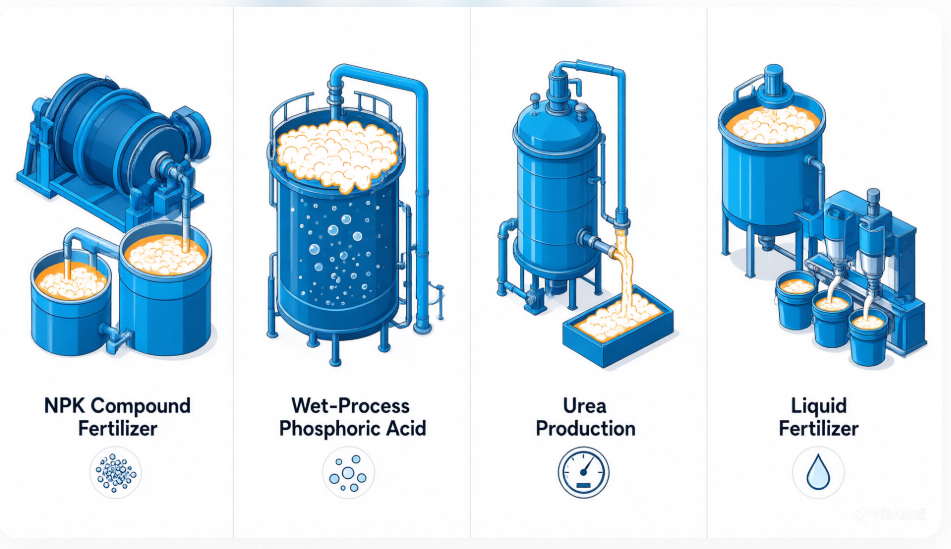
Four fertilizer production lines with typical foam control points
NPK: foam is mostly worked-in air in hot melt and slurry handling; recirculated scrubber liquor quietly carries the load higher week by week — look for fast dispersion in alkaline-ammoniacal chemistry and steady low-rate feeding.
Phosphate (wet-process): CO₂, HF and SiF₄ lift ore organics into a dense blanket over the digester and follow into evaporators — acid and heat stability over long cycles decide the pick.
Urea: biuret and accumulating impurities strengthen bubble films in vacuum concentration and melt handling — high-temperature performance, low residue, plus purge discipline around the dose.
Liquid fertilizer: humates and biostimulants are genuinely surface-active, so the foam starts at the mixing tank and ends in the packed jug — clarity, no oil bloom and shelf compatibility come first.
Two documented patterns stand out. Ordinary emulsions tend to break down in hot wet-process acid, which is why polyether-modified siloxane dispersions were developed for that duty. And when humate solutions enter a urea melt, ammonia-driven foaming can turn violent — dedicated foam-inhibition systems have been patented for exactly this process (WIPO WO 2025/147806).
Knockdown speed — how fast a worked-in foam collapses.
Hold-down — suppression of re-foaming between doses.
In-process stability — surviving the actual pH, temperature and shear of the stream.
Product compatibility — no bloom, haze or deposits; no interference with dissolution or granulation.
Handling — pumpable, easily dispersed, dilutable only on supplier-confirmed grounds.
The physics behind an effective antifoam is well established: sparingly soluble in the foaming medium, surface tension below the liquid's, balanced interface affinity, chemically non-reactive, and slow enough to volatilize that it stays where it works.
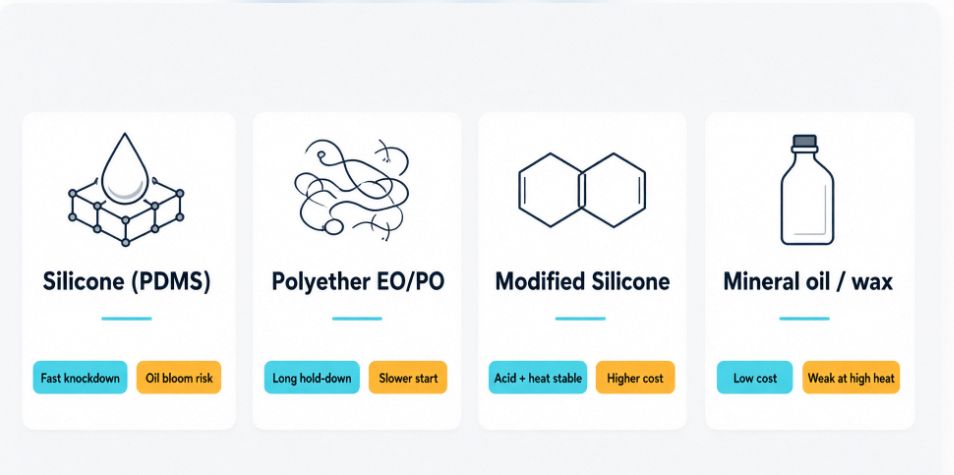
Four fertilizer defoamer chemistries compared
Silicone products (PDMS emulsions with hydrophobic silica) knock down fast, tolerate a broad pH and temperature range and work at ppm-level treatment — though they can bloom or spot in clear liquids. Polyethers (EO/PO copolymers) trade a little initial speed for persistent hold-down, disperse cleanly and carry no silicone. Polyether-modified silicones combine the spreading and the stability, with published work on hot wet-process phosphoric acid service, at a higher cost per kg. Mineral oil and wax blends stay economical on coarse aqueous streams such as scrubber liquor, where heat and pH are mild. Most plants end up pairing one chemistry per duty rather than one product per site.
Dose upstream of the shear zone — into recirculation or feed lines — rather than onto a foam crest; for batch liquid work, pre-dosing the water phase lets the antifoam occupy the gas–liquid interface before humates go in.
Continuous micro-dosing beats shock dosing.
Respect the ceiling: overdosing tends to raise condensate COD, lay films on heat-transfer surfaces, and cause re-entrainment.
The working number comes from a jar test on your own live sample, never from a copied datasheet.
Jar test at real shear, then check hold-down after 2–4 hours — not just first-look speed.
Compatibility on the finished product: appearance, dissolution rate, granule strength.
Judge cost-in-use (dose per tonne plus avoided losses), not unit price.
Q:Will a defoamer affect the fertilizer value of the finished product?
A:At ppm-level treatment, a chemistry selected for compatibility should not interfere with nutrient performance; confirm through dissolution and appearance checks on your formula.
Q:Silicone or non-silicone?
A:Silicone-based products tend to win where heat, acid or speed dominate; polyether and hybrid chemistries suit clear liquid grades and silicone-sensitive processes. Many plants run both, by duty.
Q:Can one antifoam cover the whole site?
A:It can run the whole site and optimize none of it — digesters, evaporators and the filling hall ask for different stability windows.
Start with your process in hand. Send the stage where foam appears, typical temperature and pH, a short video of the foam, your current antifoam and dose, and what the finished product must remain compliant with. We run a matched jar test and return a sample recommendation with the test record attached.