-
 中文
中文
 EN
EN
- Hotline : 0086 13929201380
- E-mail : susan@zkhtdefoamer.com gdzhonglianbang@gmail.com
-

-
ZILIBON DEFOAMER CHEMICAL
中文
EN
When many factories purchase additives, their primary concern is often the price per ton of the defoamer. Market quotations vary widely, and many purchasers tend to make decisions based solely on the price per ton. However, this often leads to issues later on, such as performance falling short of expectations and higher-than-anticipated material consumption. To select the right product, you cannot focus solely on how much the defoamer costs per ton; you must evaluate it based on a comprehensive set of criteria.
Even though they are all called defoamers, the price per ton can vary considerably. This difference mainly stems from variations in product formulations, active ingredient content, and product types.
Products with different formulation systems inherently have different raw material costs. Some products have a lower percentage of active ingredients, requiring a higher dosage in a single addition to achieve effective foam control. On the other hand, some products have a well-balanced formulation, where a small addition can maintain effectiveness for a relatively long period.
If you only focus on how much a ton of defoamers costs and choose a product with a lower quotation, the frequency of addition will increase in the later stages, and the overall consumption will actually rise. In the procurement stage, in addition to knowing the price per ton, you should also refer to the actual addition ratio and continuous performance during use.
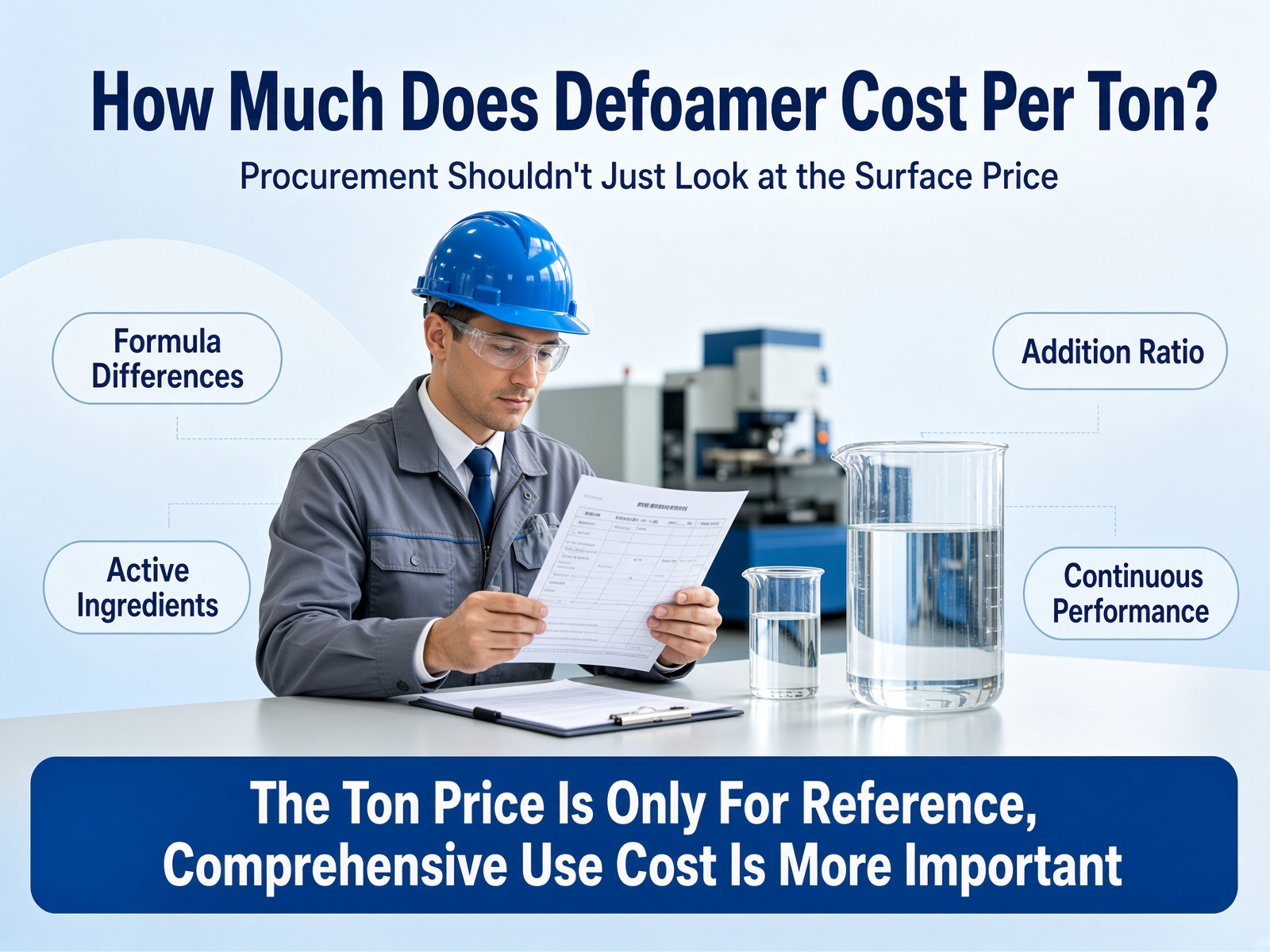
Defoamer selection guide: evaluating comprehensive cost vs price per ton
Many purchasers easily fall into the trap of comparing prices, using the purchase price per ton as the core criterion for judgment. In actual production, evaluating a product depends more on how much additive is consumed per ton of output. Some products have a moderate purchase price, but require low dosage and have a long action cycle, making overall consumption more controllable. Conversely, some low-priced products require repeated replenishment to control foam, and over the long term, the overall expenditure does not hold an advantage.
After receiving a quotation, it is recommended to calculate the actual material consumption in production based on sample test results. Use the comprehensive cost as the primary reference for purchasing, rather than just focusing on the price per ton of the defoamer.
Asking "how much is a ton of defoamer" is merely the starting point of procurement, not the entirety of product selection. Quotations fluctuate significantly due to formulations and active ingredients, so do not directly judge the quality of a product based solely on its price per ton. Prioritizing sample testing and calculating comprehensive costs by factoring in the addition ratio and sustained performance is a more reliable procurement strategy, helping factories avoid unnecessary material waste.
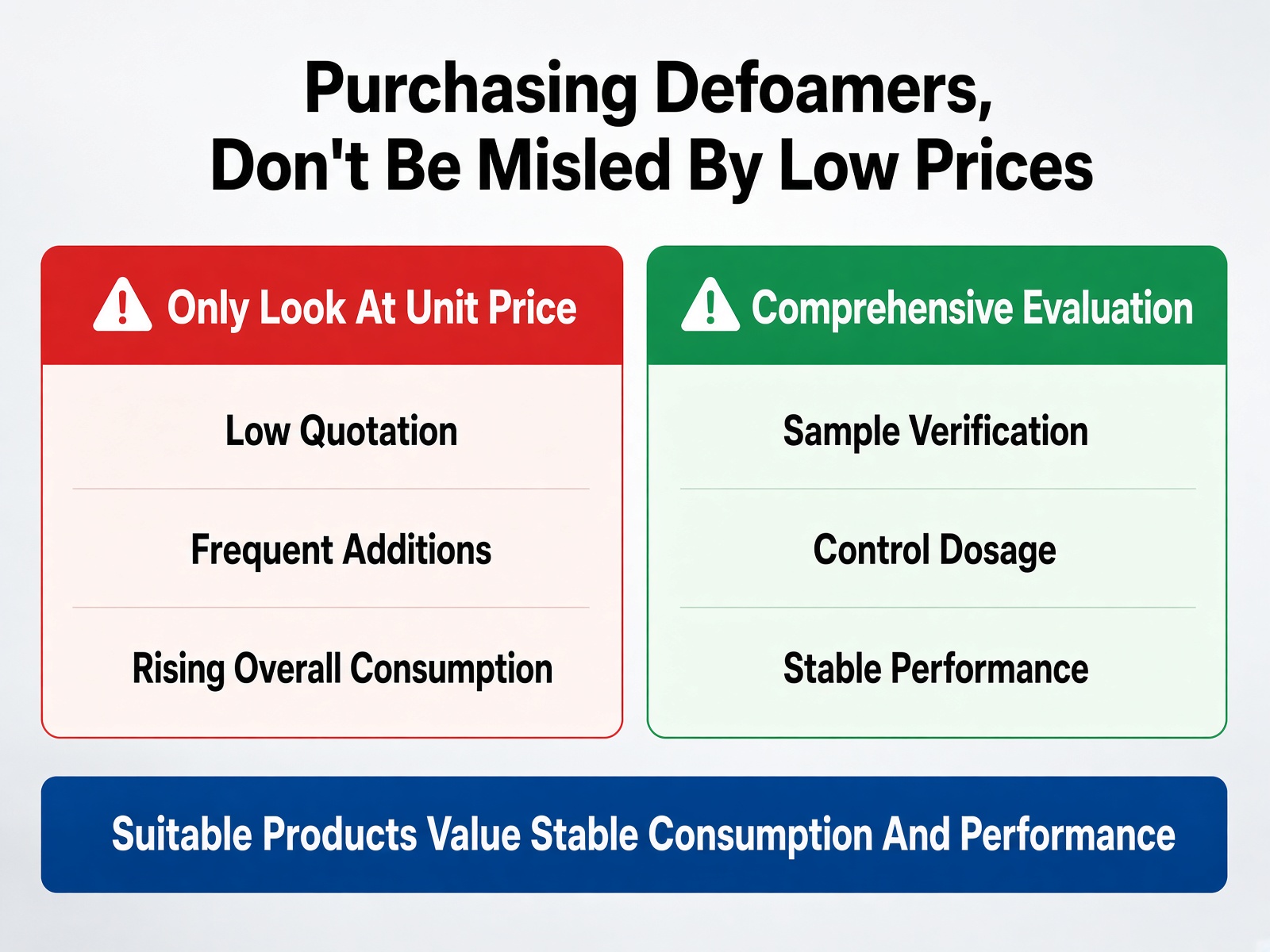
Defoamer purchasing comparison: low price trap vs comprehensive evaluation
A1: Not necessarily. The price is related to raw materials and formulation. The product that best fits your specific material system is the one most worth choosing, which needs to be confirmed through sample testing.
A2: It is not recommended. Compatibility with additives varies across different material environments. It is more prudent to complete sample testing first before proceeding with bulk procurement.
A3: By conducting sample tests to observe the foam control effect, while simultaneously checking for issues like layering or surface defects. The judgment should be made by comprehensively evaluating multiple factors.