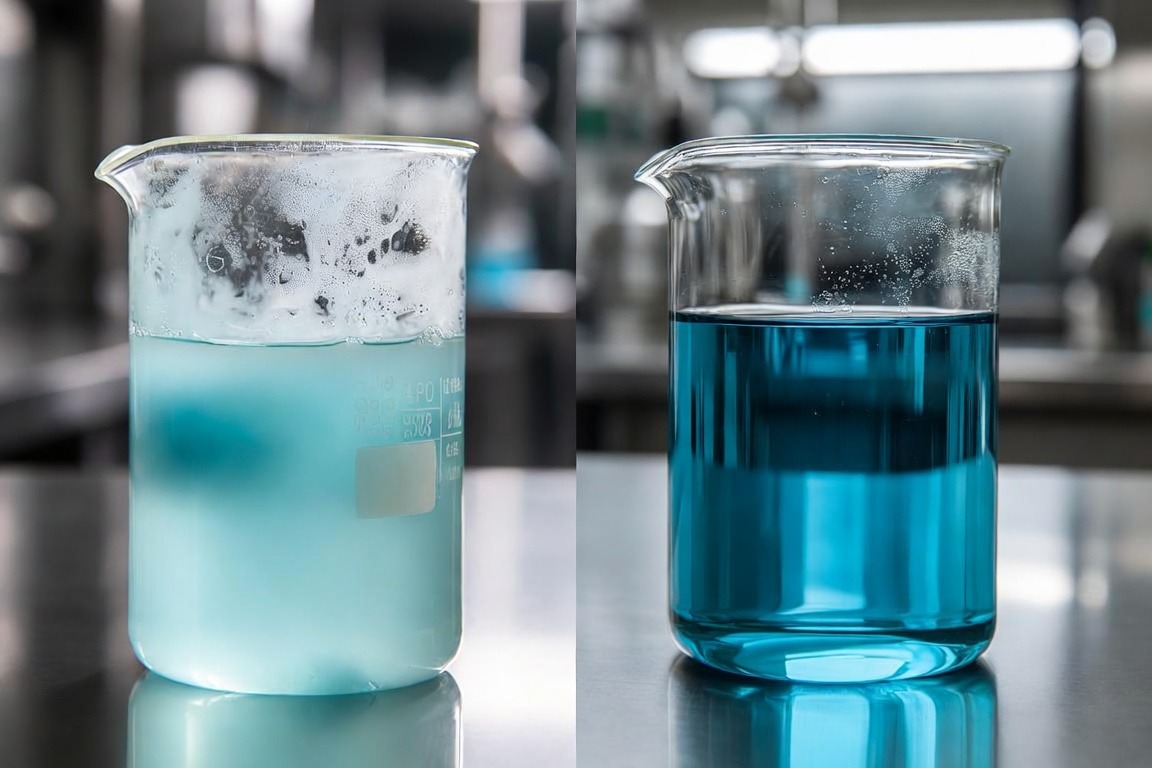
In the competitive world of laundry care, clarity is king. Consumers equate a crystal-clear liquid with purity, potency, and premium quality. However, for formulators and manufacturers, achieving that perfect transparency while maintaining high cleaning power is a delicate balancing act.
The hidden variable in this equation is often the
defoamer.
While its primary function is to control foam during high-speed filling, its secondary role—maintaining long-term stability and clarity—is what separates a market-leading product from a generic one. Here is why your choice of defoamer dictates the visual quality of your detergent.
The Transparency Paradox: High Performance vs. Visual Clarity
Modern laundry detergents are complex chemical systems. To achieve superior cleaning, formulators use high concentrations of surfactants, builders, and enzymes. This creates a high-salinity, high-alkalinity environment that is inherently hostile to many standard defoamers.
The Challenge: Traditional silicone or mineral oil defoamers often struggle to stay emulsified in these aggressive formulas. Over time, gravity and temperature fluctuations cause the defoamer droplets to coalesce and separate from the continuous phase.
The Result: Instead of an invisible additive, the defoamer becomes visible defects:
-
Turbidity: A hazy, milky appearance that suggests contamination.
-
Phase Separation: Distinct layers forming at the top or bottom of the bottle.
-
Oil Spots: Visible grease marks on packaging or fabrics.
Clarity signals quality. Don't let instability compromise your premium product
Why "Standard" Defoamers Fail in Premium Formulas
Not all defoamers are created equal. When sourcing for a transparent laundry detergent line, standard industrial grades are rarely sufficient. Here is the technical reality:
-
Emulsion Stability: In clear detergents, the defoamer must exist as microscopic droplets that match the refractive index of the surrounding liquid. If the droplet size grows (due to poor emulsification), light scatters, causing cloudiness.
-
Salt Tolerance: Many concentrated detergents rely on salts for viscosity building. Standard defoamers can "salt out," breaking the emulsion instantly upon mixing.
-
Temperature Resilience: A product that looks perfect in the lab at 25°C might turn cloudy after a week in a warm warehouse or a cold truck. High-quality defoamers are engineered to withstand thermal shock without breaking.
The Solution: Engineered Compatibility
To achieve and maintain that premium "crystal clear" look, you need a defoamer designed specifically for transparent aqueous systems.
Advanced defoamers utilize modified silicone polymers or specialized non-ionic surfactant blends that offer:
-
Micro-Emulsion Technology: Ensuring droplet sizes remain small enough to be invisible to the naked eye.
-
Broad pH Stability: Remaining stable in both acidic and highly alkaline environments.
-
Low-Temperature Clarity: Preventing haze formation even in cold storage conditions.
Elevate Your Brand with Technical Precision
Don't let a low-cost additive compromise a high-value product. The right defoamer does more than stop foam; it acts as a stabilizer that protects your brand's visual integrity from the factory floor to the consumer's laundry room.
Looking for a defoamer that guarantees clarity?
Our R&D team specializes in high-transparency defoaming solutions for the home care industry. Contact us today to request samples and technical data sheets tailored to your specific formula.
 中文
中文
 EN
EN