-
 中文
中文
 EN
EN
- Hotline : 0086 13929201380
- E-mail : susan@zkhtdefoamer.com gdzhonglianbang@gmail.com
-

-
ZILIBON DEFOAMER CHEMICAL
中文
EN
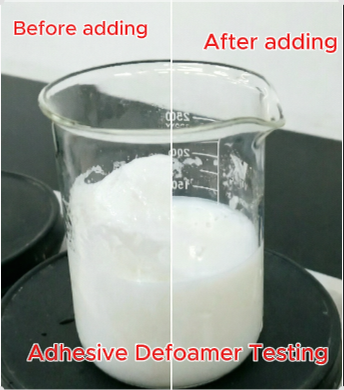
Water-based adhesives are widely used in packaging, textiles, and construction due to their low VOC emissions and environmental compliance. However, formulators face a persistent challenge during development: the formation of "fish-eyes" (cratering). These are small, crater-like defects on the surface caused by trapped foam or poor wetting during application.
These defects not only compromise aesthetic quality but can also weaken bond strength and lead to customer complaints. While traditional defoamers can solve the foam issue, they often introduce new problems: silicone migration, reduced adhesion, or incompatibility with eco-certified systems.
The Hidden Risks of Traditional Defoamers
Many standard antifoams rely on mineral oil or high-silicone content, which can lead to:
Leaving oily residues that interfere with printability or coating uniformity.
Reducing interfacial tension too aggressively, paradoxically worsening cratering.
Emulsion breaking under high shear stress, causing product separation or failure.
Key Breakthroughs in Modern Defoaming Technology
For water-based emulsion systems, next-generation defoamers achieve more precise dispersion by optimizing emulsion particle size and the Hydrophilic-Lipophilic Balance (HLB). This technology not only rapidly knocks down macro-foam but also effectively suppresses micro-bubble generation, eliminating "fish-eyes" at the source.
More importantly, premium formulations maintain high defoaming efficiency without affecting the rheology of the system. They ensure a smooth, flat coating and fully comply with international environmental standards (such as REACH and FDA).