-
 中文
中文
 EN
EN
- Hotline : 0086 13929201380
- E-mail : susan@zkhtdefoamer.com gdzhonglianbang@gmail.com
-

-
ZILIBON DEFOAMER CHEMICAL
中文
EN
In the industries of precision hardware processing, automotive parts manufacturing, and pre-plating treatment, metal cleaning is a critical step determining final product quality. However, runaway foam caused by high-pressure spraying, ultrasonic oscillation, or vigorous stirring is often an "invisible killer" on the production line.
Foam not only causes cleaning fluid overflow and pump cavitation but, more seriously, creates air barriers on workpiece surfaces, leading to incomplete cleaning. Even worse, improper defoamer selection can leave behind silicone spots, oil spots, or residues, directly causing failures in subsequent painting, plating, or welding processes.
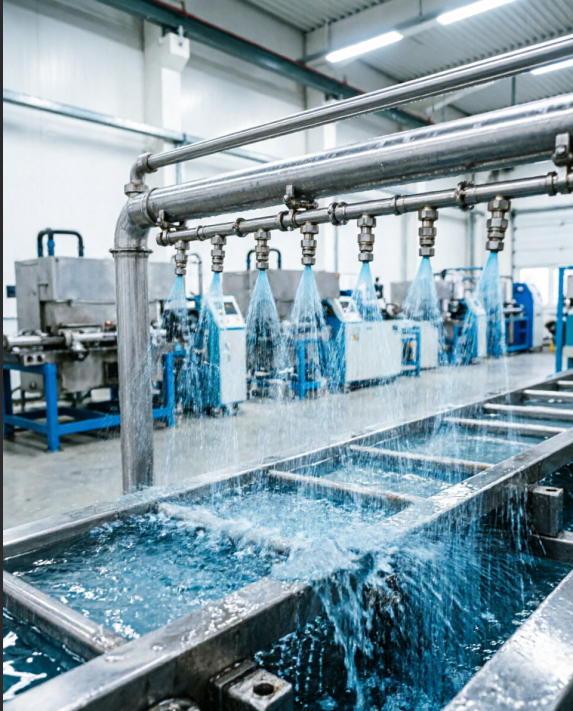
High-Pressure Spray Cleaning: Effective Foam Control with Zero Residue
Facing complex cleaning systems, how do you scientifically choose the right defoaming solution?
Technical Solutions for Different Cleaning Conditions
Different cleaning media (acidic, alkaline, neutral) and physical environments (high temperature, high shear) pose distinct challenges to the chemical stability of defoamers. Based on our 17 years of R&D experience in fluid chemistry, we offer customized solutions for the following four core pain points:
Handling High-Pressure Spraying and Strong Acid/Alkali Environments
In strong acid or alkaline cleaning fluids, standard emulsion defoamers can easily break and fail, or even separate oil that contaminates the workpiece.
Technical Strategy: We formulate for extreme chemical stability. Our solutions withstand extreme pH fluctuations and remain stable under the high shear force of high-pressure nozzles.
Key Metrics: Must ensure no oil floating, no residue, and absolutely no impact on subsequent coating adhesion.
Maintaining Transparency in Cleaning Agents
Many high-end optical glass or precision electronic cleaners require absolute transparency. Cloudiness or separation after adding a defoamer is unacceptable.
Technical Strategy: We use specialized emulsification processes to achieve molecular-level dispersion.
Key Metrics: Excellent water solubility and compatibility, rapidly eliminating foam while completely maintaining the transmittance of the cleaning fluid.
Powder Cleaning Systems and High-Temperature Conditions
Powder cleaners tend to generate dense foam during dissolution and use, and some degreasing processes involve high temperatures.
Technical Strategy: We develop specialized powder defoamer carriers that blend perfectly with cleaning powders and remain chemically inert at high temperatures.
Key Metrics: Strong heat resistance, non-toxic, non-corrosive, and maintains high foam suppression efficiency even after dilution.
Efficient Treatment for General Cleaning Fluids
For routine water-based cleaning processes, customers prioritize cost-effectiveness and environmental friendliness.
Technical Strategy: We optimize formula structures to eliminate unnecessary organic solvents.
Key Metrics: Free of organic solvents, non-corrosive to equipment, and possesses excellent resistance to high shear forces.
Why Choose Customized Formulation Testing?
Off-the-shelf defoamers often only solve "visible" foam while ignoring "invisible" risks (like affecting weldability or causing coating craters). Our R&D team advocates for "Diagnosis First, Formulation Second."
We don't just sell products; we provide laboratory simulation testing tailored to your specific conditions (temperature, pH, agitation speed). Only formulas that pass compatibility and durability tests are recommended for your production line.
Expert Tip: Every cleaning system is unique. If you are facing foam issues or wish to optimize your current cleaning costs, contact our technical team today for a free sample testing proposal.